Schedule FA from Morgan Stanley — Complete Walkthrough
9 min read · Published July 2026 · Applies to AY 2025-26 and AY 2026-27
- First: StockPlan Connect or E*TRADE? The migration explained
- What is Schedule FA and who must file
- Which reports to download from StockPlan Connect
- Table A2 — Morgan Stanley custodial account
- Table A3 — Equity interest (one row per vest lot)
- Table F — Morgan Stanley Participant Trust
- Common mistakes — the gross-vs-net shares trap
- Morgan Stanley vs Fidelity vs Schwab vs E*TRADE
- Automate with itrfa.in
 Watch: Schedule FA in 2 minutes — Morgan Stanley StockPlan Connect
1. First: StockPlan Connect or E*TRADE? The migration explained
Morgan Stanley bought E*TRADE in 2020 and, between 2023 and 2025, moved most Morgan Stanley at Work stock plan participants onto the E*TRADE platform. Depending on where your employer's plan sits today, "my RSUs are with Morgan Stanley" means one of two very different portals:
| You log in at… | Your platform | Which flow to follow |
|---|---|---|
| stockplanconnect.com | StockPlan Connect (legacy Morgan Stanley portal) | This guide. Select Morgan Stanley (StockPlan Connect) as your broker on itrfa.in. |
| us.etrade.com | Morgan Stanley at Work on the E*TRADE platform | The E*TRADE guide — your exports (Holdings, Gains & Losses, Transactions) are E*TRADE's. Select E*TRADE / Morgan Stanley at Work on itrfa.in. |
| shareworks.solium.com or atwork.morganstanley.com/solium | Shareworks by Morgan Stanley (Solium platform, rebranded Morgan Stanley at Work) | Now supported. Shareworks has no Releases/Withdrawals report, but the dedicated Shareworks guide covers how to enter your vest lots directly, or upload your Statement of Account PDF for AI-assisted prefill. |
If your account migrated mid-year, you may need Table A2 rows for both platforms in the transition year, with Table A3 lots sourced from whichever portal holds the history. The rest of this guide covers the StockPlan Connect path.
2. What is Schedule FA and who must file
Schedule FA is a section of ITR-2 and ITR-3 where Indian residents disclose foreign financial assets. It was introduced under the Black Money (Undisclosed Foreign Income and Assets) and Imposition of Tax Act, 2015.
You must file Schedule FA if you are a Resident and Ordinarily Resident (ROR) in India and hold any of the following:
- Foreign bank or brokerage accounts (including Morgan Stanley / StockPlan Connect)
- Foreign equity shares — vested RSUs/GSUs, ESPP shares, or direct purchases
- Beneficial interest in foreign trusts (the stock plan participant trust qualifies)
- Any other foreign financial asset with value > ₹0
There is no minimum threshold. Even ₹1 of foreign assets requires disclosure. Non-residents (NR) and Not Ordinarily Resident (NOR) are exempt.
See full penalties and legal obligations →
3. Which reports to download from StockPlan Connect
StockPlan Connect is different from Fidelity, Schwab, and E*TRADE in one important way: it has no holdings export and no gains/losses export. There is no file that lists your current lots with cost basis, and no file that pairs each sale with its acquisition date. What it does have — under Activity → Reports — is two flat activity reports, and together they contain everything Schedule FA needs:
One row per vest event. The three columns that matter:
Vest Date — your Table A3 acquisition date.
Price — the vest-date fair market value. This is your correct India cost basis (the amount your employer already taxed as perquisite), even where a Morgan Stanley statement prints "Cost Basis $0.00".
Net Share Proceeds — the shares actually deposited after sell-to-cover withholding. This, not the gross Quantity column, is your lot size.
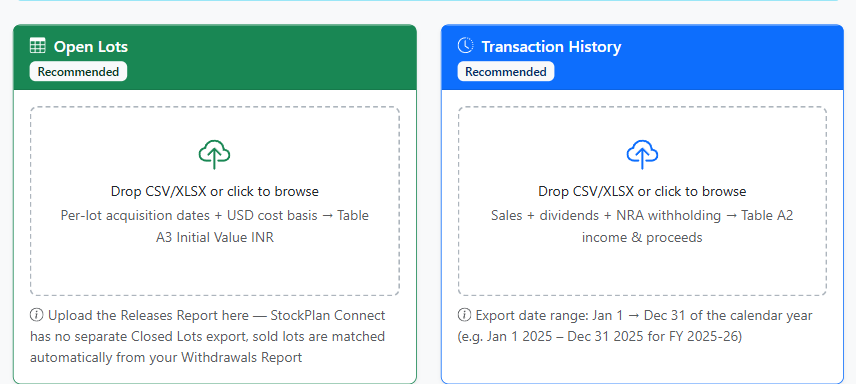
Upload this file in the Open Lots slot. Used for: Table A3 initial value INR (vest-date FMV × SBI TTBR on the vest date, per CBDT's Schedule FA filing instructions — see the free TTBR lookup).
One row per sale (Type = "Sale"), with execution date, share quantity, and net amount. Rows with Plan = "Cash" are the proceeds being swept out as cash — they are the same money again, not a second sale, and itrfa.in skips them automatically.
Upload this file in the Transaction History slot. Used for: Table A2 gross proceeds, plus reconstructing which vest lots your sales came from — since StockPlan Connect has no gains/losses export, sold lots are matched to Releases lots first-in-first-out (FIFO), the same matching your CA would do by hand.
4. Table A2 — Foreign Custodial Account
Table A2 covers the Morgan Stanley account itself (the brokerage wrapper). One row per account.
| Field | What to Enter | Source |
|---|---|---|
| Country Name and Code | 2-UNITED STATES OF AMERICA (dropdown selection, not a typed code) | Fixed |
| Name of Institution | Morgan Stanley Smith Barney LLC | Fixed |
| Address | 1585 Broadway New York NY 10036 United States (no commas — the portal rejects them) | Fixed |
| Account Number | Your StockPlan Connect participant/account number | Morgan Stanley statement |
| Status | Owner, Beneficial Owner, or Beneficiary — your relationship to the account (there's no "Active/Inactive" option) | Fixed — usually Beneficial Owner |
| Peak Balance (INR) | Max(shares × stock price) across the calendar year (Jan–Dec) × SBI TTBR on that peak date | Daily prices + SBI TTBR (peak date) |
| Closing Balance (INR) | Shares × stock price on Dec 31 × SBI TTBR Dec 31 | Daily prices + SBI TTBR (exact date) |
| Nature of Amount + Amount | One dropdown value (Dividend/Interest/Proceeds from Sale/Other) + its own amount, per row | Statements / Withdrawals Report |
5. Table A3 — Foreign Equity Interest
Table A3 requires one row per lot — for Morgan Stanley RSU/GSU holders that means one row per vest event from the Releases Report.
| Field | What to Enter | Releases Report column |
|---|---|---|
| Entity Name | Company whose shares you hold (e.g. Alphabet Inc.) | — (type the ticker on the review screen) |
| Nature of Entity | Equity shares — N shares acquired DD/MM/YYYY | Plan + Vest Date |
| Date of Acquiring | Vest date | Vest Date |
| Initial Value (INR) | Net shares × vest-date FMV × SBI TTBR on vest date | Net Share Proceeds × Price |
| Peak Value (INR) | Lot's shares × highest price during the calendar year × SBI TTBR on that peak date | Computed from daily prices |
| Closing Value (INR) | Shares × Dec 31 price × SBI TTBR Dec 31 (0 if sold during the year) | Computed |
| Total Income (INR) | 0, unless a dividend can be matched to this specific holding — then it goes here instead of only in Table A2 | — |
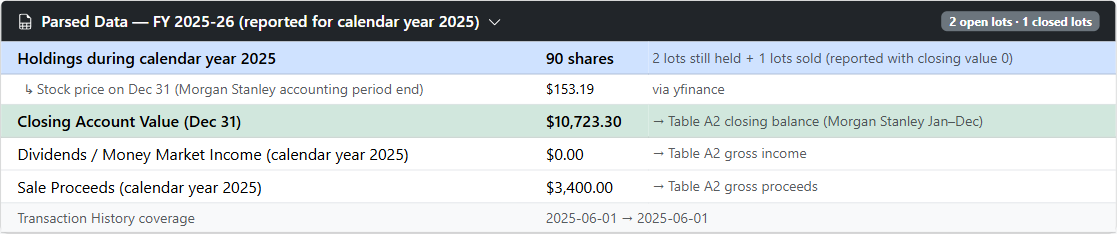
Sold lots still get a row. A lot sold in June was held from January to June — it must appear in Table A3 for that year with gross proceeds filled in and closing value 0. Because StockPlan Connect has no gains/losses export, itrfa.in reconstructs these rows by FIFO-matching your Withdrawals Report sales against your Releases Report vests. See capital gains on sold RSUs →
For unvested RSUs: also disclose in Table A3 as beneficial interest. Initial value = 0 (you haven't received them yet). Closing value = unvested units × Dec 31 stock price × SBI TTBR. See full RSU guide →
6. Table F — Morgan Stanley Participant Trust
Employer stock plans administered by Morgan Stanley hold unvested RSU/GSU awards through a stock plan arrangement before they vest. As a plan participant, you have a beneficial interest in this arrangement — which a conservative filing discloses as a foreign trust in Table F.
In practice, many CAs omit Table F on the grounds that the beneficial interest is already captured in Table A3. However, a conservative filing includes it. Fields required:
- Trust Name: Morgan Stanley Smith Barney LLC Participant Trust
- Country: UNITED STATES OF AMERICA
- Trustee: Morgan Stanley Smith Barney LLC, 1585 Broadway, New York, NY 10036
- Settlor / Employer: Your employer name and address
- Date of creation: Your first RSU grant date (approximate)
- Beneficiary details: Beneficial interest as plan participant
7. Common mistakes — the gross-vs-net shares trap
-
Using the gross Quantity instead of Net Share Proceeds.
The Releases Report shows both:
Quantityis the full vested count (say 100),Net Share Proceedsis what landed in your account after sell-to-cover withholding (say 60). Your Table A3 lot is 60 shares — reporting 100 overstates every value on the row and double-counts shares that were sold on day one for US tax. -
Treating the statement's "$0.00 Cost Basis" as your initial value.
Some StockPlan Connect statement formats print Cost Basis as $0.00 for RSU shares because you paid nothing for them. For India, the correct basis is the vest-date FMV — the amount already taxed as salary perquisite. That figure is the Releases Report's
Pricecolumn. Reporting ₹0 initial value is wrong. - Counting the "Cash" rows in the Withdrawals Report as extra sales. Each stock sale is followed by a Plan = "Cash" row when the proceeds are swept out — same dollars, second row. Summing all rows double-counts your gross proceeds. (itrfa.in skips Cash rows automatically.)
- Forgetting dividends — the reports don't carry them. Neither the Releases nor the Withdrawals Report lists dividend credits. If your stock pays dividends (Alphabet started in 2024, Microsoft and Apple always have), pull the amounts from your StockPlan Connect statements or year-end tax documents and add them to Table A2 gross income. This is the one number the two reports cannot give you.
- Using Income-tax Rule 115's preceding-month rate instead of the correct exact-date rule for Schedule FA. Schedule FA values must use CBDT's Schedule FA filing instructions: SBI TTBR on the exact acquisition/event date. Using the wrong rule can cause a 15–20% difference in INR values. See Rule 115 guide →
- Using March 31 as closing date instead of Dec 31. Schedule FA reports the calendar year ending Dec 31 — closing balance means Dec 31 stock price × Dec 31 SBI TTBR, for both Table A2 and Table A3.
8. Morgan Stanley vs Fidelity vs Schwab vs E*TRADE
The Schedule FA rules are identical regardless of broker — CBDT's exact-date SBI TTBR rule, the Dec 31 closing date, and the per-lot Table A3 requirement all apply the same way. What changes is the export mechanics, and Morgan Stanley's are the most unusual:
| Fidelity | Schwab | E*TRADE | Morgan Stanley (StockPlan Connect) | |
|---|---|---|---|---|
| Open lots export | Open Lots CSV | Lot Details (per symbol) | Holdings → By Status | None — reconstructed from Releases Report |
| Closed lots export | Closed Lots CSV | Realized Gain/Loss | Gains & Losses | None — FIFO-matched from Withdrawals Report |
| Ticker in export | — | Yes | Yes | No — plan name only ("GSU Class C") |
| Dividends in export | Transaction History | Transactions | Transactions | No — check statements manually |
| RSU cost-basis gotcha | — | — | Acquisition Cost shows $0 | Statement shows $0 — use Releases Price column |
| Table A2 institution | Fidelity Investments (NetBenefits) | Charles Schwab & Co., Inc. | E*TRADE Securities LLC | Morgan Stanley Smith Barney LLC |
9. Automate with ITRFA.in
Manual filing from StockPlan Connect data involves:
- Downloading the Releases and Withdrawals Reports
- Working out net shares per vest lot and discarding the Cash sweep rows
- FIFO-matching every sale to its vest lots to reconstruct sold-lot rows
- Looking up SBI TTBR rates for every vest date (often 10–20 dates)
- Looking up daily stock prices to find the true peak balance
- Computing INR values for every lot and entering 15–30 rows into ITR-2
ITRFA.in does all of this from your two report uploads — select Morgan Stanley (StockPlan Connect) as your broker, drop the Releases Report in the Open Lots slot and the Withdrawals Report in the Transaction History slot, type your stock ticker once on the review screen, and download ITR-ready JSON + Excel in under 2 minutes.

Upload your StockPlan Connect Releases + Withdrawals Reports → get Table A2, A3, F with correct SBI TTBR rates and FIFO-matched sold lots. Takes 2 minutes. ₹399 for full INR values + JSON + Excel download.
Convert Morgan Stanley reports to Schedule FA →